```html
The chemistry of cement hydration is a delicate balance of timing and temperature. For most construction projects, the goal is to maintain workability for a sufficient period, allowing for mixing, transport, and placement. However, in the realm of concrete technology, two specific phenomena often arise that challenge this timeline: Flash Set and False Set. While historically viewed as problematic material failures, the modern construction industry has harnessed the principles of rapid setting to create high-performance products. By examining the chemical mechanisms of flash setting and the engineering solutions provided by industry leaders like ARIT, we can better understand how to control and utilize this rapid hydration process.
The Chemistry of Flash Set
What is flash set in cement? At its core, the setting of cement is a chemical reaction between water and the mineral components of the cement clinker. The most reactive of these components is Tricalcium Aluminate (C₃A). Under normal conditions, gypsum (calcium sulfate) is added during the grinding of cement clinker to regulate the hydration of C₃A. The gypsum reacts with C₃A to form ettringite, which creates a protective layer around the cement particles, slowing down the setting process and allowing the concrete to remain fluid.
A flash set occurs when there is insufficient gypsum to control the C₃A hydration, or if the C₃A is exceptionally reactive. A flash set is characterized by a rapid, irreversible hardening of the cement paste shortly after the addition of water. This process is highly exothermic, meaning it releases a significant amount of heat. Unlike other forms of premature stiffening, a flash set cannot be reversed by adding more water or by continued mixing; the chemical bonds formed are permanent, and any attempt to disturb them will result in a total loss of structural integrity.
Flash Set vs. False Set
It is essential for site engineers to distinguish between a flash set and a False Set. While both involve a sudden loss of workability, their causes and remedies are vastly different.
A False Set is often a result of the dehydration of gypsum during the milling process. If the grinding mill becomes too hot, the gypsum (CaSO₄·2H₂O) loses part of its water of crystallization, turning into plaster of hemihydrate. When water is later added at the job site, this hemihydrate rapidly re-hydrates back into gypsum crystals, causing the mix to stiffen. Crucially, a false set does not generate significant heat, and the workability can often be restored through vigorous re-mixing without the addition of extra water.
In contrast, the Flash Set is a true chemical reaction of the aluminates. Because it is permanent and generates high heat, it is usually considered a severe defect in standard ready-mix concrete, leading to equipment damage and failed pours.
ARIT’s High-Performance Admixtures
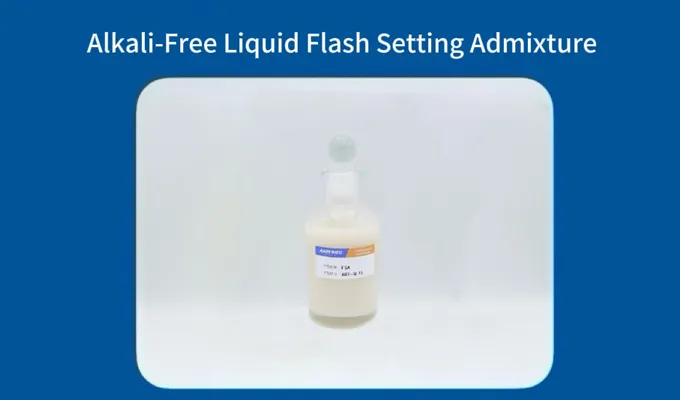
While an accidental flash set is a disaster on a standard construction site, an engineered flash set is a vital tool for specialized applications. This is where companies like ARIT provide critical value. ARIT specializes in Flash-Setting Admixtures, which are designed to accelerate the hydration process to an extreme degree under controlled conditions.
According to ARIT’s product specifications, flash-setting admixtures are primarily used in shotcrete (sprayed concrete) and emergency repair scenarios. In these contexts, the goal is to transform the concrete from a liquid or plastic state to a solid state within seconds or minutes of application.
Applications in Shotcrete and Tunneling
In tunneling and mining, shotcrete must be applied to vertical surfaces or overhead arches. Without a flash-setting agent, the wet concrete would succumb to gravity and fall away before it could bond. ARIT’s flash-setting admixtures allow the concrete to freeze in place almost instantly upon contact with the substrate. This rapid hardening ensures:
Reduced Rebound: Less material is wasted as it sticks effectively to the surface.
Structural Safety: In unstable ground conditions, the immediate gain in compressive strength provides essential support to the rock face or tunnel walls.
Efficiency: Multiple layers can be applied in a single pass, significantly speeding up construction timelines.
The Benefits of Controlled Rapid Setting
The use of engineered flash-setting agents provides several advantages beyond mere speed. High early strength is the hallmark of these admixtures. In emergency infrastructure repairs, such as fixing a busy highway or a leaking dam, waiting 28 days for concrete to reach full strength is not an option. ARIT’s technology enables materials to achieve significant load-bearing capacity within hours.
Furthermore, these admixtures are formulated to be compatible with various cement types, ensuring that the rapid set does not compromise the ultimate long-term durability of the structure. By carefully dosing these accelerators, engineers can fine-tune the setting time to match the environmental conditions, such as extreme cold, which would normally retard the hydration of standard concrete.
The flash setting of cement represents a fascinating intersection of chemical volatility and engineering precision. While the flash set serves as a warning of chemical imbalance and potential project failure, the flash-setting admixtures developed by ARIT demonstrate how this same rapid reaction can be harnessed for groundbreaking construction techniques.
Understanding the difference between the exothermic, irreversible flash set and the milder false set is crucial for quality control in the field. Simultaneously, embracing advanced admixtures allows the industry to push the boundaries of what is possible in tunneling, mining, and rapid repair. In the modern era, flash setting is a sophisticated solution for the world's most challenging environments.
```


 English
 tiếng việt
 العربية
 বাঙালি
 සිංහල
සිංහල