Slump retention refers to the ability of freshly mixed concrete to maintain its initial workability or consistency ("slump") over time, rather than stiffening too quickly after mixing. In other words, it’s a measure of how long concrete remains workable enough for placing, pumping, finishing, etc., without needing re-mixing or adding extra water.
The retention time of concrete typically refers to how long a certain desirable concrete property is retained after mixing.
Workability Retention/Slump Retention Time: How long concrete remains sufficiently fluid or workable after mixing, before it stiffens to a point where placing, finishing, or pumping becomes difficult.
Setting Time: The time from adding water until the concrete begins to lose plasticity (initial setting), or until it fully loses plasticity (final setting). Although setting time is slightly different, retention of workability is closely tied to setting behavior.
Strength Development/Curing Retention: How long concrete needs to be cured moist to retain the moisture and environmental conditions to continue gaining strength. Sometimes retention time is loosely used in this context.
The primary function of slump retention agent is to maintain the flowability or workability of concrete within a specified time frame, meeting the operational requirements under various construction conditions to ensure the quality of the corresponding project.
Slump retention agents are used under conditions where high temperatures, dry environments, or excessive water demand of raw materials in the concrete can lead to rapid workability loss. Additionally, they are necessary when existing high-strength prefabricated concrete has an initial low slump (non-flowable) and must maintain its slump for an extended period due to construction constraints.
Based on the characteristics of concrete, high temperatures accelerate the bonding between cementitious materials and other components, hastening the loss of workability. To ensure normal construction progress and maintain the operability of concrete at structural points, an appropriate proportion of slump retention agents should be added to the corresponding admixture.
Slump retention agents are a multi-component polymer that acts as a lubricant between cement particles, preventing them from bonding for an extended period, thereby enhancing and maintaining concrete's flowability.
Currently, high-performance concrete widely uses polycarboxylate-based high-performance water-reducing agents. The most notable issue is that the quality problems of cement, blended materials, sand, and stone (containing mud) lead to accelerated slump loss when polycarboxylate high-efficiency water reducers are used. Therefore, adding an appropriate amount of slump retainers can prevent or reduce concrete slump loss.
Traditional methods often involved adding a significant amount of retarders to achieve short-term effects. However, the set-retarding components in modern high-performance admixtures (polycarboxylate-based) do not affect the initial and final set times of the concrete.
The set-retarding components in polycarboxylate-based admixtures are designed specifically to control workability loss over time. The normal hardening time remains unchanged, maintaining the strength development pattern.
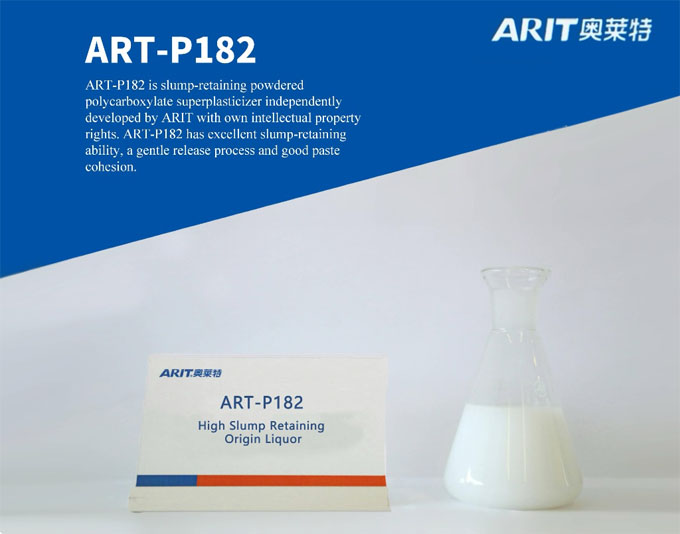
Arit Slump Retention Admixture
| High Slump Retaining Origin Liquor | Medium Slump Retaining Origin Liquor |
| ART-M233 | ART-620 |
| ART-P182 | ART-M22 |
| ART-M630 | |
| ART-M640 |
 English
 tiếng việt
 العربية
 বাঙালি
 සිංහල
සිංහල