Name
Shuangyumen Bridge Main Tower Project
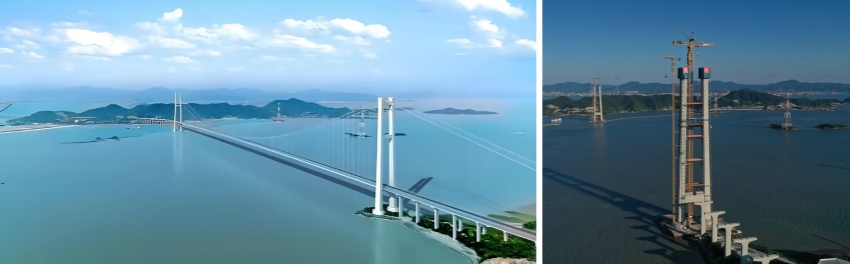
Pic.Shuangyumen Bridge
Shuangyumen Bridge is a critical control bridge for the second phase of the Liuheng Highway Bridge project of Ningbo-Zhoushan Port. Located in Zhoushan City, Zhejiang Province, it connects Liuheng Island and Fodu Island. It is the world's longest single-span steel box girder suspension bridge with a span of 1,768 meters, and also the longest sea-crossing bridge in China, setting a new record for the maximum span of sea-crossing bridges in China at 1,768 meters. The bridge towers adopt a portal-shaped steel-concrete structure with heights of 246.3 meters and 254 meters respectively. Construction of the bridge began on November 2, 2022, and the main project was officially launched in March 2023. In November of the same year, the steel cofferdam for the main piers was lowered into place, entering the construction phase of the offshore main tower caps. In April 2024, the cap concrete pouring on the Fodu side was completed, fully transitioning to the tower column construction phase. By November, the anchor concrete pouring volume exceeded 10,000 cubic meters; the anchor foundation pit is 82 meters long, 58.1 meters wide, and up to 30 meters deep at its deepest point. In May 2025, the Liuheng side tower height exceeded 200 meters. On September 6, the east main tower was capped, employing a steel skeleton and concrete collaborative load-bearing system, using 12,000 tons of steel bars, 32,000 cubic meters of concrete, and 3,500 tons of steel sections. On September 27, the main tower on the Fodu side was capped (tower height 254 meters), with a total of approximately 60,000 cubic meters of concrete poured, 5,261 tons of pre-embedded steel sections, and 8,625 tons of steel bars used. Upon completion, the bridge will create a 10-minute vehicular passage from Liuheng Island to Ningbo, ending the era of Meishan, Liuheng, and Fodu islands having no expressway access, and promoting the integration of Ningbo-Zhoushan and the development of the marine economy. During construction, a steel structure virtual assembly prediction system was developed and applied, and a "intelligent hydraulic climbing formwork + steel section modularization" technical system was adopted. Zhoushan's first bridge drone intelligent supervision base was established, achieving dynamic linkage supervision of "drones + control room + maritime patrol boats."
(1) The concrete used for the main towers of sea-crossing bridges differs significantly from ordinary concrete. It must possess ultra-high strength, extreme durability, excellent workability, and volume stability to ensure a 100-year service life for the bridge in the marine environment. The concrete strength grade is typically C50 or higher; the Liuheng main tower utilizes C50 marine high-performance concrete, with its core focus being resistance to chloride ion penetration to prevent steel reinforcement corrosion. This is achieved by controlling the chloride ion diffusion coefficient of the concrete, employing high-performance marine concrete, and ensuring adequate protective cover thickness. Additionally, the concrete should exhibit volume stability, low hydration heat, and minimal shrinkage and creep during the hardening process to reduce cracking risks and ensure the integrity and long-term safety of the main tower structure.
(2) The main towers of sea-crossing bridges often reach heights exceeding one hundred meters, requiring concrete to be pumped to high altitudes for placement (such as the main pier towers of the Hangzhou Bay Sea-crossing Bridge). This imposes extremely high demands on concrete workability: the concrete must possess high fluidity, good cohesion, and water retention, maintaining uniformity without segregation or bleeding after long-distance, high-lift pumping. During construction, placement should be conducted in layers with a thickness not exceeding 30 cm, ensuring thorough vibration compaction. Upon completion of placement, timely curing should be performed (for example, tower column concrete may be cured by applying curing compounds after formwork removal, with a curing period generally no less than 14 days) to prevent plastic shrinkage cracks on the surface.
In terms of mix proportion, as the pumping height of the main tower increases, the requirements for concrete workability and cohesion are elevated. Therefore, it is necessary to increase the sand ratio based on the original mix design. Generally, the sand ratio for C50 river sand concrete is around 39%, but it needs to be increased to approximately 44% to ensure more adequate concrete paste. Regarding air content, due to the high pumping height and to guarantee the concrete's encapsulation properties, the air content should be as high as possible while ensuring strength, with good air retention performance as well.
For detailed remixing formula, feel free to contact technicians of ARIT
Address
22 Huixin Road, Nanjing, China
Call us
Email us
Connect with ARIT for Premium Concrete Additives Wholesale

 English
 tiếng việt
 العربية
 বাঙালি
 සිංහල
සිංහල