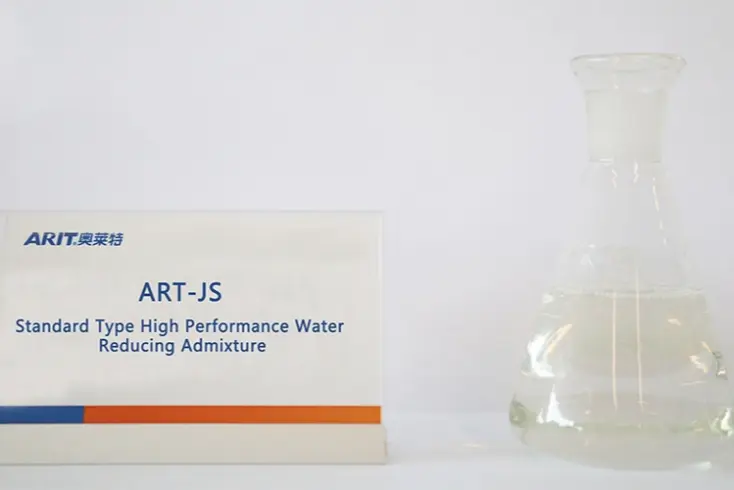
One of the most direct routes to lower-carbon cement is to use less clinker and more supplementary cementitious materials (SCMs), such as slag, fly ash and calcined clay. However, reducing the clinker content creates immediate challenges: slower early hydration, delayed demoulding and greater difficulty in cold-weather construction. This has drawn growing attention to nano-calcium silicate hydrate (C–S–H) seeding early-strength admixtures, whose particles typically range from tens to hundreds of nanometres. Rather than relying on aggressive chemical acceleration, these seeds provide pre-existing nucleation interfaces that facilitate hydrate precipitation. Yet an important question arises as the dominant hydrates in low-carbon binders change: should we continue using exactly the same C–S–H seeds? This question is precisely why calcium aluminosilicate hydrate (C–A–S–H) seeds deserve attention.
When water is added to cement, the clinker phases first dissolve and release Ca-, Si- and Al-bearing species. These species then accumulate in the pore solution. Extensive hydrate precipitation begins only after sufficient local supersaturation develops and stable nuclei form. The pivotal step is nucleation. Without seeds, hydrates must establish a new foundation on an empty site. Adding well-dispersed nano-C–S–H is analogous to distributing numerous microscopic foundations throughout the cement paste. Hydration precursors can accumulate, associate and grow near these interfaces, thereby lowering the nucleation barrier for stable hydrates. C–S–H seeding therefore does more than make cement react faster. It changes where and when hydrates precipitate, and how they occupy the pore space. Seminal studies have shown that well-dispersed nano-C–S–H seeds can shorten the induction period, advance heat evolution and promote early hydrate formation. Redistributing hydrates from clinker surfaces into capillary pore space may also improve particle bridging and microstructural connectivity. These effects explain the growing use of C–S–H seeds in precast concrete, cold-weather construction, low-clinker cements and rapid-demoulding applications.
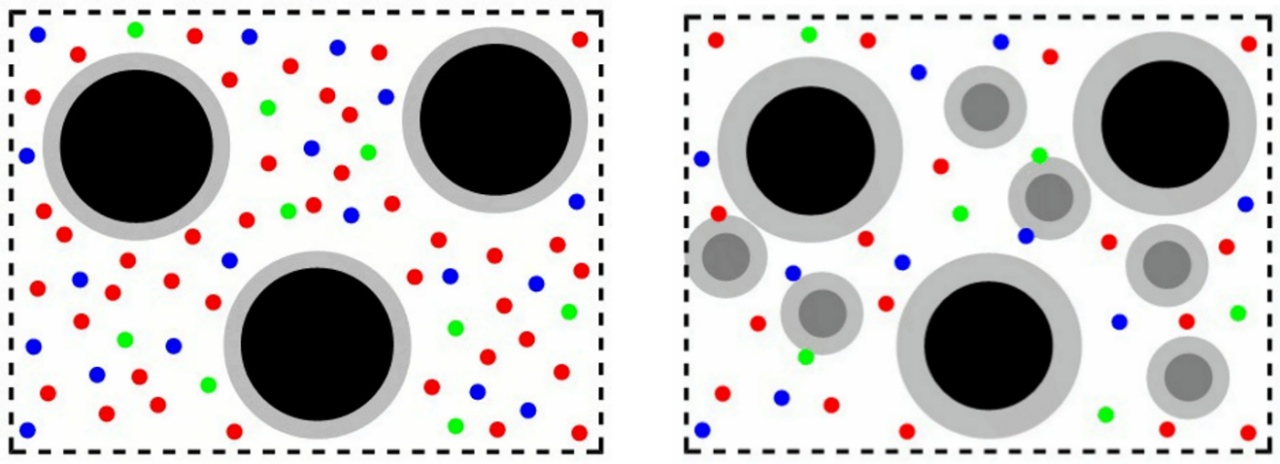
Figure 1. Seed-mediated hydration mechanism.
Calcium silicate hydrate (C–S–H) is one of the principal hydration products in conventional Portland cement. Using C–S–H to induce further C–S–H growth is therefore intuitively reasonable. However, the increasing use of slag, fly ash and calcined clay introduces more Al into modern binder systems. Consequently, the principal binding phase can shift from relatively conventional C–S–H towards Al-bearing calcium aluminosilicate hydrate, or C–A–S–H. At first glance, the difference appears to be only an additional “A”. At the atomic scale, however, Al produces far more complex changes. Silicate tetrahedra in C–S–H form chain-end, paired and bridging sites. When Al is incorporated, tetrahedrally coordinated Al can participate in bridging configurations within aluminosilicate chains. Under suitable conditions, this incorporation can increase chain connectivity and mean chain length. Different Al coordination environments can also affect the interlayer structure, charge compensation and the local environments of Ca and OH groups. C–A–S–H is therefore not simply “C–S–H plus a little Al”. Its chain topology, local charge, bridging sites, interlayer ions and surface hydroxyl environment may all change. Crucially, these changes occur where seeding matters most: at the surface.
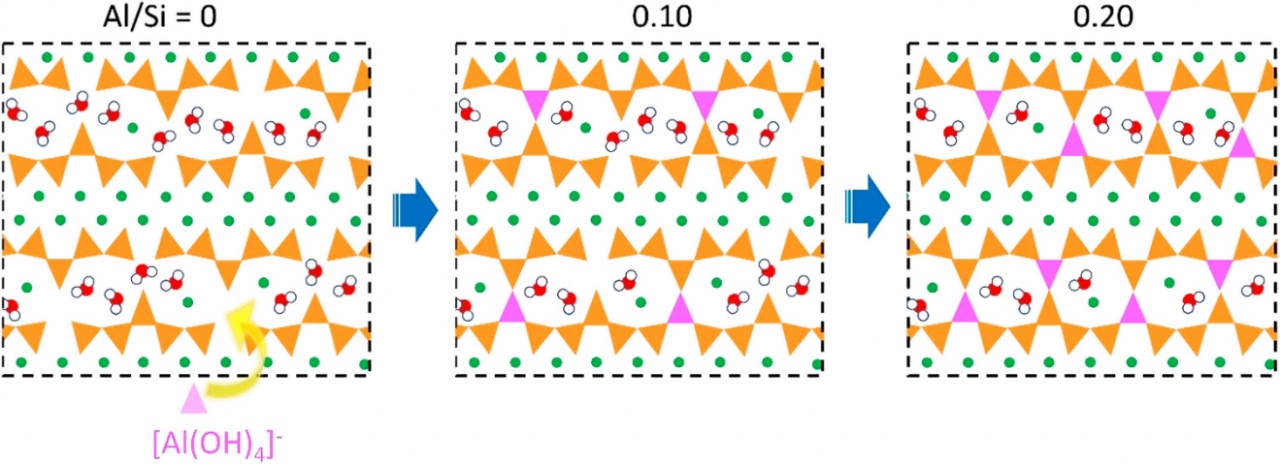
Figure 2. Schematic of the Al-induced bridging effect in C–(A)–S–H. Orange and pink triangles denote silicate and aluminate tetrahedra, respectively; green circles denote calcium atoms, and red and white spheres denote water molecules.
Nano-seeds have traditionally been assessed using several familiar metrics: particle size, specific surface area and dispersion stability. These properties remain important. Yet heterogeneous nucleation raises a more fundamental question: is the atomic structure of the seed surface compatible with the hydrate that must grow on it? Hydrates do not nucleate within the seed particle. Adsorption, dehydration, association and nucleation occur within the outermost atomic layers. These layers may contain silanol groups, several types of surface hydroxyls, bridging or coordinated Ca, and oxygen sites with different charge states. They may also contain ordered or disordered interfacial water and adsorbed Ca²⁺, silicate and aluminate species. Seed efficiency may therefore be governed by a complex surface-chemical fingerprint. A C–S–H surface has an intuitive advantage when the target phase is C–S–H. However, if C–A–S–H predominates in binders rich in slag or calcined clay, could a C–A–S–H surface provide a better template for its own nucleation? This is a mechanistically plausible scientific hypothesis, although it should not yet be treated as a universal rule.
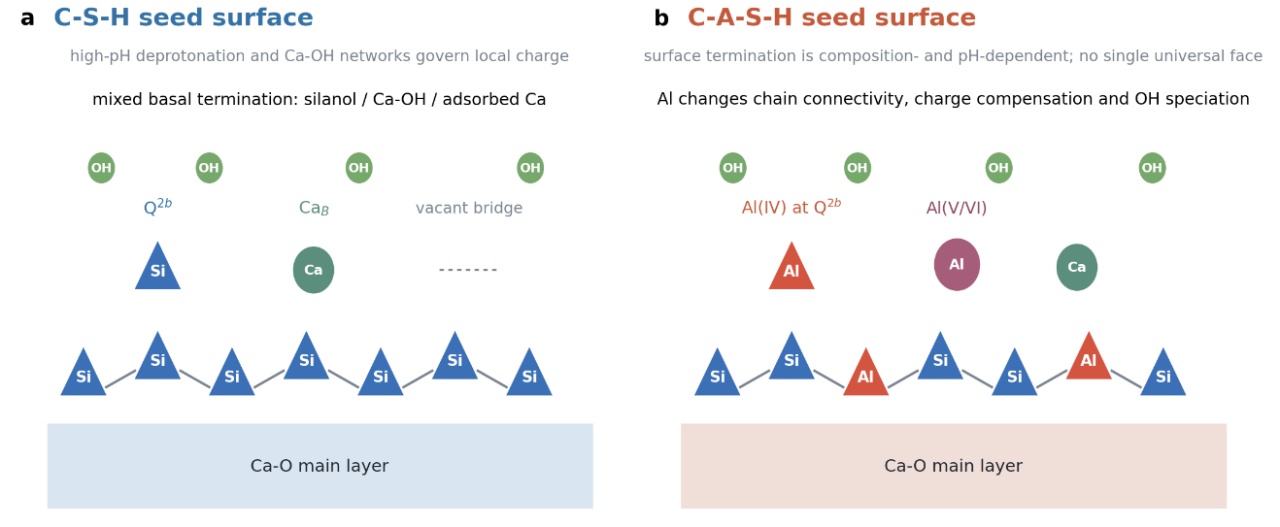
Figure 3. Conceptual comparison of heterogeneous nucleation on C–S–H and C–A–S–H seed surfaces.
Recent experiments have begun to address this question. In 2021, researchers introduced Al into C–S–H in the presence of a polycarboxylate ether (PCE) to prepare C–A–S–H/PCE nanocomposite seeds. The resulting material showed promising advantages in early-strength enhancement and dispersion retention. A subsequent study of cement containing 50% metakaolin showed that a higher seed Al/Si ratio was not always better. Seeds with Al/Si = 0.10 performed best. They advanced the second main calorimetric peak by approximately 6.7 h and were associated with a higher metakaolin degree of reaction and greater C–A–S–H formation. The low-temperature results are particularly noteworthy. In a study conducted at 10 °C, conventional C–S–H seeds substantially shortened the setting time, while introducing an appropriate amount of Al further enhanced this effect. C–A–S–H seeds with Al/Si = 0.08 reduced the initial and final setting times by approximately 53.6% and 44.5%, respectively. Further Al addition weakened the effect, owing to particle coarsening and reduced dispersion stability. This finding provides an important lesson: seed performance is not determined by atomic-scale sophistication alone. The overall outcome reflects the combined effects of favourable surface structure, effectively dispersed surface area and compatibility with the binder system.
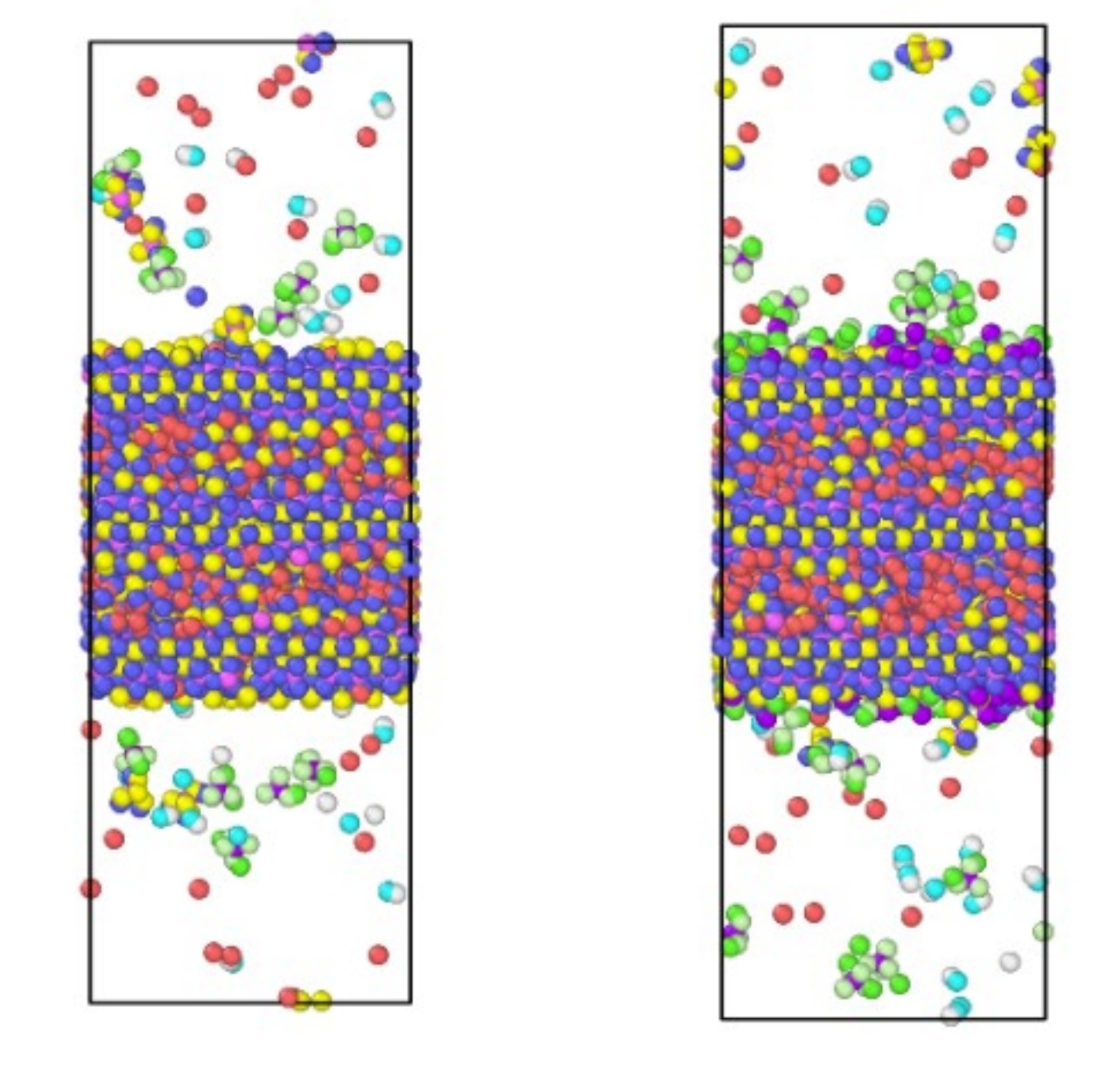
Figure 4. Molecular-dynamics interpretation.
If this concept proves valid, the design of seeding early-strength admixtures may change substantially. Traditional optimisation has focused mainly on particle size, specific surface area, solids content and dispersion stability. Future designs may also need to control Ca/Si, Al/Si, Al coordination, bridging-site populations, surface hydroxyls, protonation states and interfacial charge. In other words, seeds may no longer follow a one-product-fits-all strategy. Instead, they could be tailored to specific binder chemistries. In high-clinker ordinary Portland cement, the target gel remains predominantly C–S–H, and conventional C–S–H seeds may retain high efficiency. For slag-rich binders, seed surfaces compatible with Al-rich C–A–S–H warrant consideration. In calcined-clay-rich or limestone calcined clay cement (LC³) systems, early hydration pathways also depend on the balance among Al, Ca, Si and sulfate. Ultimately, future products may extend beyond simple “C–S–H seeds” or “C–A–S–H seeds” towards families of system-specific seeds with deliberately tailored surface chemistries.
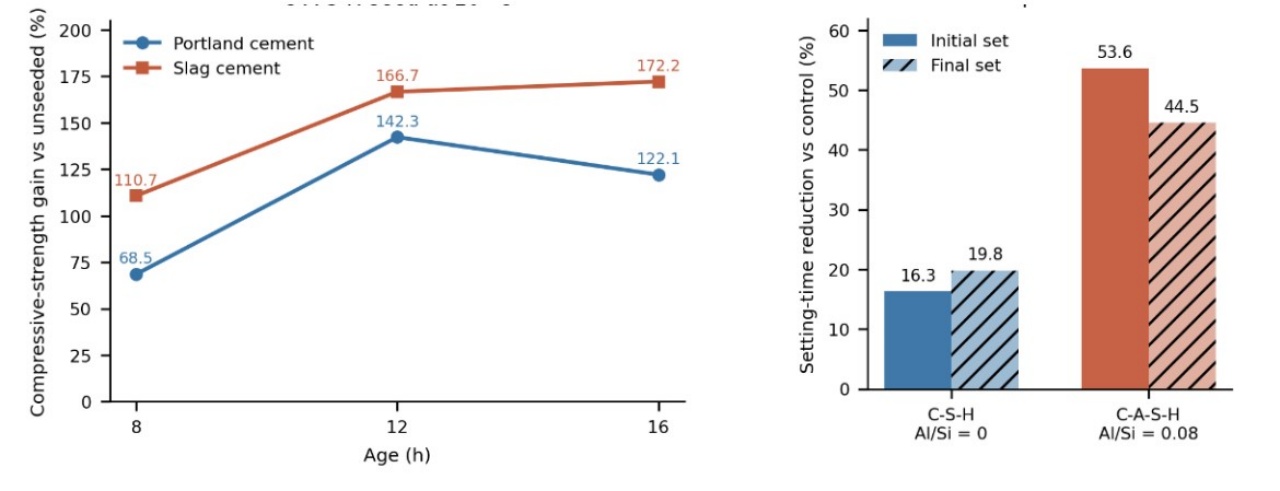
Figure 5. Comparison of C–S–H and C–A–S–H seeds at 10 °C.
This is the most compelling promise of seeding early-strength admixtures. Conventional approaches to early strength often rely on a higher clinker content, elevated curing temperatures, prolonged steam curing or large dosages of soluble accelerators. Seeding follows a different route. It does not necessarily supply more reactants; instead, it helps existing hydration reactions occur more readily in the right locations. Future research should establish a continuous causal chain linking seed-surface atomic structure, interfacial water, Ca/Si/Al adsorption, prenucleation species, hydrate growth, pore structure and early strength. Once this chain is resolved, seeding admixtures will no longer be viewed merely as conventional early-strength additives. They will instead function as nanoscale regulators of hydration pathways. Such control could help lower the clinker factor, reduce steam-curing demand, improve cold-weather construction and enable the next generation of low-carbon precast concrete.
1. Thomas, J. J., Jennings, H. M. & Chen, J. J. J. Phys. Chem. C, 4327–4334 (2009). [DOI](https://doi.org/10.1021/jp809811w)
2. John, E., Matschei, T. & Stephan, D. Cem. Concr. Res., 74–85 (2018). [DOI](https://doi.org/10.1016/j.cemconres.2018.07.003)
3. Cuesta, A. et al. Materials, 1462 (2023). [DOI](https://doi.org/10.3390/ma16041462)
4. Casar, Z. et al. J. Phys. Chem. C, 18652–18661 (2023). [DOI](https://doi.org/10.1021/acs.jpcc.3c03350)
5. Churakov, S. V. et al. J. Phys. Chem. C, 11752–11762 (2014). [DOI](https://doi.org/10.1021/jp502514a)
6. Andersen, M. D., Jakobsen, H. J. & Skibsted, J. Cem. Concr. Res., 857–868 (2004). [DOI](https://doi.org/10.1016/j.cemconres.2003.10.009)
7. Kunhi Mohamed, A. et al. J. Am. Chem. Soc. (2020). [DOI](https://doi.org/10.1021/jacs.0c02988)
8. Li, J. et al. Cem. Concr. Res., 367–378 (2019). [DOI](https://doi.org/10.1016/j.cemconres.2018.09.008)
9. Li, Y. et al. Nat. Commun., 5352 (2025). [DOI](https://doi.org/10.1038/s41467-025-60631-6)
10. Zou, F. et al. Chem. Eng. J., 128569 (2021). [DOI](https://doi.org/10.1016/j.cej.2021.128569)
11. Liu, X. et al. J. Build. Eng., 105844 (2023). [DOI](https://doi.org/10.1016/j.jobe.2023.105844)
12. Wang, X. et al. J. Environ. Manage. 118658 (2023). [DOI](https://doi.org/10.1016/j.jenvman.2023.118658)
13. Wang, X. et al. Adv. Powder Technol., 104623 (2024). [DOI](https://doi.org/10.1016/j.apt.2024.104623)
14. Kanchanason, V. & Plank, J. Cem. Concr. Res., 44–50 (2019). [DOI](https://doi.org/10.1016/j.cemconres.2019.01.007)
15. Zhao, D. & Khoshnazar, R. Cem. Concr. Compos., 104162 (2021). [DOI](https://doi.org/10.1016/j.cemconcomp.2021.104162)
16. Li, X., Dengler, J. & Hesse, C. Cem. Concr. Res., 107151 (2023). [DOI](https://doi.org/10.1016/j.cemconres.2023.107151)
17. Schack, T., Strybny, B. & Haist, M. Materials, 4509 (2024). [DOI](https://doi.org/10.3390/ma17184509)
18. Alzaza, A. et al. Cem. Concr. Compos., 104319 (2022). [DOI](https://doi.org/10.1016/j.cemconcomp.2021.104319)
19. Lu, J. et al. Advanced Engineering Sciences, 265–273 (2025). [DOI](https://doi.org/10.12454/j.jsuese.202400254)
This is the first one.
 English
 tiếng việt
 العربية
 বাঙালি
 සිංහල
සිංහල