Water is essential for concrete mixing, but excessive mixing water can negatively affect strength, durability, and dimensional stability. Water-reducing admixtures provide a practical way to improve concrete workability while controlling water demand. For contractors, ready-mix producers, precast manufacturers, and construction material distributors, choosing the right water reducing agent supplier is therefore an important part of concrete mix design and quality control.
A modern water reducer can help concrete achieve the required slump without simply adding more water. The American Concrete Institute explains that water-reducing admixtures can improve strength and workability while reducing the water requirement for a given slump. ARIT, develops and supplies concrete chemical admixtures, including finished water-reducing products designed for different performance requirements. Its product range includes high-performance water-reducing admixtures, high-range water-reducing admixtures, functional admixtures, and special building materials.
A water-reducing admixture is a chemical additive used in concrete to reduce the amount of mixing water required to achieve a specified level of workability or slump.
The basic principle is relatively simple. Cement particles tend to attract one another during mixing, which can trap part of the available water. Water-reducing admixtures help disperse cement particles, allowing the mixture to maintain workability with less water.
According to the Federal Highway Administration, water-reducing admixtures can reduce water demand while maintaining workability and can contribute to increased strength and lower permeability. This makes water reducers particularly useful when a project requires a combination of flowability, strength, durability, and controlled water-to-cementitious-material ratios.
Reducing water does not automatically mean making concrete too stiff. The objective is to maintain the required workability while lowering unnecessary water demand.
Depending on the concrete mixture and admixture type, water reduction can provide several potential benefits:
Improved compressive strength
Better workability
Reduced permeability
Improved durability
Lower cement demand in certain mix designs
More efficient concrete production
Better control of concrete performance
ARIT states that its water-reducing products can provide water reduction ranging from approximately 10% to 65%, depending on product requirements and solid content. Actual performance, however, should always be established through project-specific testing.
Not every concrete application requires the same level of water reduction. A professional water reducer manufacturer should therefore provide products with different performance characteristics rather than treating every project with a single formulation.
ARIT categorizes its finished products into several groups, including high-performance water-reducing admixtures and high-range water-reducing admixtures.
High-performance water reducers are designed for concrete where high water reduction, strength development, workability, and durability are important.
ARIT's finished product range includes ART-JS, ART-JA, and ART-JR under its high-performance water-reducing admixture category. The company describes this group as offering water-reducing performance, strength effects, workability, and durability.
These products can be considered for demanding concrete production where performance requirements extend beyond basic workability improvement.
High-range water reducers, commonly associated with superplasticizing performance, can achieve substantially greater water reduction than conventional water reducers.
ASTM C494 classifies Type F as a high-range water-reducing admixture and Type G as a high-range water-reducing and retarding admixture.
ARIT lists ART-JS2 and ART-JR2 under its high-range water-reducing admixture category and describes the group as offering good water reduction and broad compatibility.
Some projects require more than basic water reduction. Functional admixtures can be used to introduce or modify specific characteristics of a concrete admixture system.
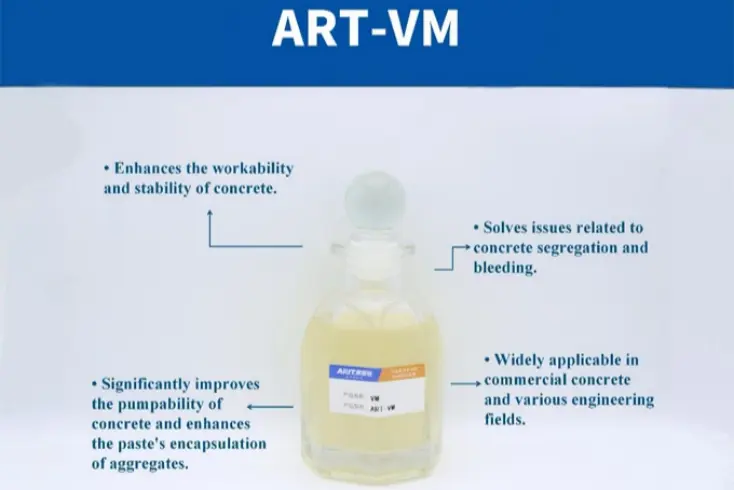
ARIT lists functional products including ART-P-CASH, ART-MGX, ART-ZQB, ART-CASH, ART-ZQA, ART-ZJL, ART-CS, ART-AC, ART-VM, ART-VR, ART-S33, ART-AE, and ART-DF.
The company describes these materials as low-dosage products that can be remixed with different water-reducing admixtures to obtain various functions.
For specialized projects, this type of formulation flexibility can be valuable because concrete performance depends on cement, aggregates, supplementary cementitious materials, temperature, mixing sequence, transportation time, and other variables.
Choosing among water reducer manufacturers involves more than comparing product prices. A suitable supplier should be able to demonstrate consistent product quality, technical knowledge, application experience, and the ability to support mix optimization.
First, determine the required water reduction, slump, setting behavior, strength development, and durability requirements.
ASTM C494 establishes performance categories for chemical admixtures and includes testing requirements related to water content, setting time, strength, flexural performance, length change, and durability depending on the admixture category.
Compatibility is one of the most important considerations when selecting a water reducer supplier.
Two admixtures with similar general descriptions may perform differently with different cement chemistries. ASTM specifically recommends testing admixtures with the cement, pozzolan, aggregates, air-entraining admixture, mixture proportions, batching sequence, and other conditions proposed for the actual project.
ARIT likewise recommends conducting compatibility trials with cement before use to determine an appropriate dosage.
The correct dosage depends on the product, concrete composition, required performance, and site conditions. More admixture does not necessarily mean better concrete.
A qualified technical team should evaluate:
Cement type and content
Water-to-cementitious-material ratio
Aggregate grading
Supplementary cementitious materials
Target slump
Concrete temperature
Transportation distance
Mixing sequence
Required setting time
Required early and later-age strength
For buyers comparing water reducer suppliers, the following checklist can simplify the procurement process.
Evaluation Factor | Why It Matters | Questions to Ask the Supplier |
Water reduction | Determines mix efficiency | What water reduction range is achievable? |
Compatibility | Affects consistency and performance | Can the product be tested with our cement? |
Workability | Influences pumping and placement | How does it affect slump retention? |
Strength | Important for structural applications | What performance testing is available? |
Setting behavior | Affects construction scheduling | Does the product influence setting time? |
Product consistency | Supports batch-to-batch quality | How is quality controlled? |
Technical support | Helps optimize dosage | Is application support available? |
Supply capacity | Prevents project interruptions | Can the supplier support bulk orders? |
A professional water reducer supplier should be prepared to discuss these issues before commercial supply begins.
Water reducers are used across many concrete applications.
ARIT identifies high-speed railways, expressways, bridges, precast components, and other large-scale concrete applications among the fields where water-reducing admixtures can be used.
Ready-mix producers need consistent workability from batching through transportation and placement. Water reducers can help achieve target slump without simply increasing mixing water.
This is particularly valuable when concrete must be pumped or transported over significant distances.
Precast manufacturers often require controlled workability, efficient production cycles, and predictable strength development.
A suitable water-reducing admixture can help optimize the mixture while supporting production consistency.
Infrastructure projects place demanding requirements on concrete durability and strength. FHWA identifies water-reducing admixtures as one of the technologies used to improve concrete performance by reducing water demand while maintaining workability.
High-performance concrete often combines a low water-to-cementitious-material ratio with high workability. High-range water reducers are especially relevant because they can provide substantial water reduction while maintaining flowability.
FHWA notes that high-range water reducers can reduce water demand by approximately 12–40% in the applications discussed in its technical material.

For international buyers, choosing a water reducer manufacturer instead of purchasing an unknown generic product can provide advantages in technical communication, product consistency, customization, and supply planning.
ARIT presents itself as a water reducer manufacturer and supplier specializing in concrete admixtures. Its finished-product portfolio covers multiple water-reducing categories and also includes functional admixtures and special building materials.
A manufacturer-oriented supplier can also help buyers move beyond a simple “price per ton” comparison.
The more meaningful question is:
How much concrete performance can the admixture deliver at the required dosage and total mix cost?
For example, if an admixture enables a producer to reduce water while maintaining the required slump and strength, the resulting mix may offer efficiency benefits that are not visible from the purchase price of the admixture alone.
When purchasing from water reducer factories, buyers should establish clear technical and commercial requirements before placing a bulk order.
Specify whether the product will be used for ready-mix concrete, precast concrete, infrastructure, pumping applications, high-performance concrete, or another purpose.
Request technical documentation and conduct laboratory or trial batching with the actual cement and aggregates whenever possible.
This is important because admixture performance is influenced by the complete concrete system rather than by the admixture alone. ASTM C494 specifically highlights the importance of testing with materials and mixture conditions proposed for the actual work.
For large projects, supply reliability matters as much as laboratory performance. Buyers should evaluate production capacity, batch consistency, packaging, delivery schedules, storage requirements, and technical support.
ARIT offers a broad finished-product portfolio for concrete admixture applications. Its water-reducing range includes high-performance and high-range products, while its functional admixture portfolio provides additional formulation options.
The company's product structure is designed around different concrete performance requirements rather than a one-product-fits-all approach.
For buyers searching for water reducing agent suppliers, this broader product approach can be useful when projects involve different cement systems, concrete grades, production methods, or environmental conditions.
ARIT also provides technical resources such as data sheets, quality-control information, technical help, research and development resources, and concrete mix design support through its website.
The most appropriate product should still be selected through technical evaluation and compatibility testing rather than keyword matching or price comparison alone.
Selecting the right water reducer can influence concrete workability, water demand, strength, durability, and overall mix efficiency. For this reason, contractors and concrete producers should evaluate water reducer manufacturers according to both product performance and technical support.
A reliable water reducing agent supplier should offer multiple product categories, consistent quality, compatibility testing, technical assistance, and dependable supply.
With its portfolio of high-performance water-reducing admixtures, high-range water-reducing admixtures, functional admixtures, and related concrete materials, ARIT provides a broad solution range for concrete producers and construction material buyers.
For any project, the final choice should be confirmed through laboratory trials using the actual concrete materials and production conditions. This approach provides a more reliable basis for achieving the required balance of workability, water reduction, strength, durability, and cost.
A water-reducing admixture is a chemical additive that reduces the amount of mixing water required to achieve a specified concrete consistency or slump. It can help improve workability and may support higher strength when the water-to-cementitious-material ratio is reduced.
A conventional water reducer provides water reduction within the requirements of its applicable performance category, while a high-range water reducer is designed for substantially greater water reduction. ASTM C494 identifies Type F as a high-range water-reducing admixture and Type G as a high-range water-reducing and retarding admixture.
Evaluate the supplier's product performance, compatibility testing, quality control, technical support, production capacity, documentation, and delivery capability. Price should be considered together with the dosage and resulting concrete performance.
They can contribute to higher strength when water reduction results in a lower water-to-cementitious-material ratio while maintaining the required workability. The actual strength result depends on the complete concrete mixture and curing conditions.
Yes. Compatibility testing with the cement, aggregates, supplementary cementitious materials, mixture proportions, and production conditions is recommended before full-scale use. ASTM C494 specifically recommends project-specific testing where practicable.
Water reducers are commonly used in ready-mix concrete, precast components, bridges, highways, high-speed rail projects, and other large-scale concrete construction. ARIT identifies these application areas within its product information.
A manufacturer may provide stronger technical communication, product consistency, formulation support, testing assistance, and long-term supply planning. However, buyers should evaluate each supplier individually based on verified quality, technical capability, and project requirements.
Notice: All images in this article are generated by Artificial Intelligence according to prompts.
This is the first one.
 English
 tiếng việt
 العربية
 বাঙালি
 සිංහල
සිංහල