Project name:
China State Shipbuilding Corporation Development Datong Tianzhen Wind Turbine Tower Project
Cangzhou Jianhua Building Materials Co., Ltd. manufactures wind turbine tower segments primarily for the CSSC Development Datong Tianzhen project. The main construction scope covers the hybrid tower T1 section. The tower adopts a conical structural design with an overall height ranging from 140 m to 160 m, a bottom outer diameter of 8.4 m, and a top outer diameter of 4.36 m. Each segment has a height of 3 m. The concrete is specified as Grade C80 with a required slump of 180–220 mm.
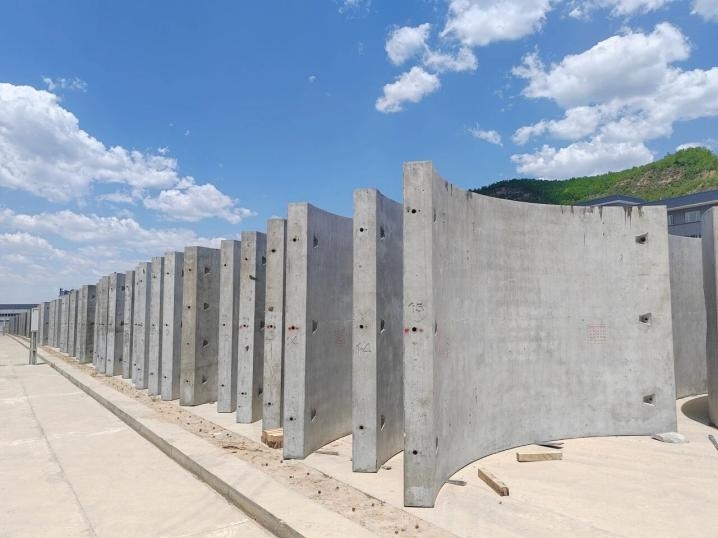
Figure 1. On-site Components
Dimensional Accuracy and Consistency Control of Precast Components
The wind turbine concrete tower features large dimensions and a special cross-sectional profile. Manufactured in a factory using horizontal steel molds, the production process imposes extremely stringent requirements on mold fabrication precision, overall rigidity, and surface flatness. During batch production, strict control over mold assembly, disassembly, and closure tolerances is essential. Any deviation may result in dimensional non-conformance of tower segments, adversely affecting the precision of on-site assembly and jointing.
Layered Casting and Compaction Control
The tower is produced using a horizontal layered casting process (2–3 layers). The interfaces between layers are prone to weak bonding and cold joints. In addition, compaction relies on table vibrators for air evacuation and densification. The control of vibration parameters, casting speed, and inter-layer intervals is highly demanding. Deficiencies in these aspects may lead to honeycombing, pitting, bubbles, and voids—both on the surface and internally—directly compromising the structural durability and mechanical performance of the tower.
Curing Cycle and Production Rhythm Coordination
The project adopts natural curing, with a curing period extending from 48 to 72 hours. Demolding is permitted only after the concrete has attained at least 70% of its design strength. Natural curing is significantly influenced by ambient temperature, humidity, and weather conditions, resulting in considerable variation in strength development rates. This makes it difficult to determine the precise demolding time and constrains production line turnover efficiency, leading to limited capacity and significant scheduling pressure.
Reinforcement Cage Fabrication and Installation Accuracy
The tower reinforcement cage is massive and intricately detailed. Factory-based fabrication requires precise control over steel bar cutting, tying, and shaping. During placement within the steel mold, strict control of concrete cover thickness, bar spacing, and overall verticality is necessary. Positioning and alignment are highly challenging, and even minor deviations can impair the structural performance and final quality of the component.
A redesigned concrete mix was developed with the following parameters: target density of 2,500 kg/m³, binder content of 550 kg/m³, slag powder at 8%, microsphere at 8%, water-to-binder ratio of 0.27, sand ratio of 39%, coarse aggregate proportion of 1:9, and the addition of an appropriate dosage of defoaming agent.
For detailed remixing formula, feel free to contact the technicians at ARIT.
Address
22 Huixin Road, Nanjing, China
Call us
Email us
Connect with ARIT for Premium Concrete Additives Wholesale
 English
 tiếng việt
 العربية
 বাঙালি
 සිංහල
සිංහල